

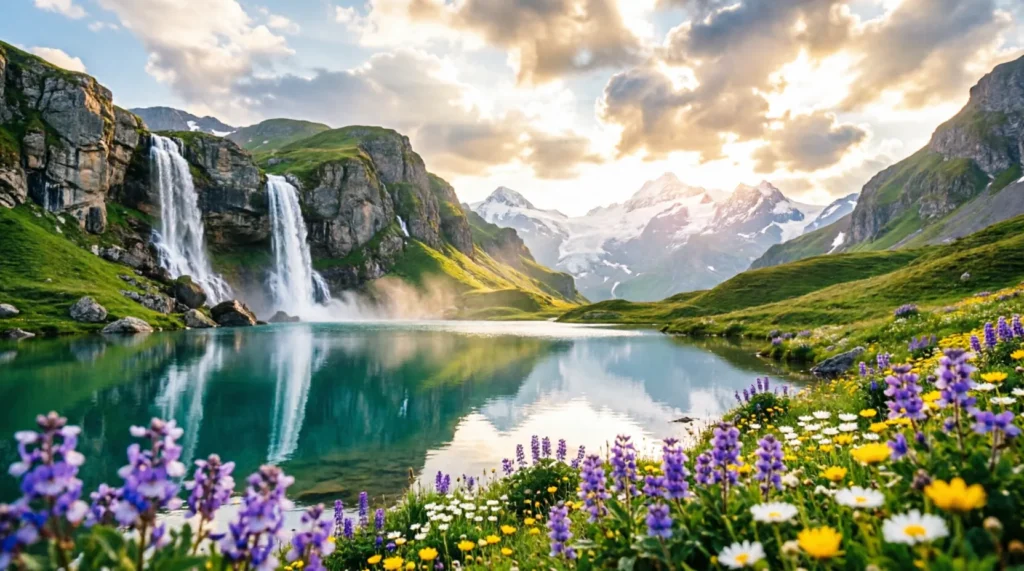
When you’re trying to capture the essence of a stunning location, similes give readers an instant visual anchor by comparing your place to something familiar yet striking. The collection below organizes similes by the feeling and setting they evoke, each demonstrated in a real sentence so you can see exactly how it works on the page.
Natural Landscapes and Scenery
Nature provides the richest source material for describing beautiful places, and these similes tap into universal experiences of the outdoors.
“as pristine as a mountain lake at dawn” — “The valley stretched out before us, as pristine as a mountain lake at dawn.” (pure, untouched, reverent)
“as vibrant as a wildflower meadow in full bloom” — “The garden courtyard was as vibrant as a wildflower meadow in full bloom.” (energetic, colorful, joyful)
“as endless as the ocean horizon” — “From the clifftop, the view was as endless as the ocean horizon.” (vast, overwhelming, humbling)
“as dramatic as a canyon at sunset” — “The rock formations stood as dramatic as a canyon at sunset.” (striking, bold, visually intense)
“as delicate as morning dew on spider silk” — “The frost-covered branches were as delicate as morning dew on spider silk.” (fragile, intricate, fleeting) Craft note: This one works because of the alliteration in “delicate” and “dew,” plus the unexpected specificity of spider silk—it’s visual but also tactile.
“as wild as an untamed forest” — “The coastal path wound through terrain as wild as an untamed forest.” (untamed, adventurous, raw)
“as serene as a still pond reflecting clouds” — “The Japanese garden was as serene as a still pond reflecting clouds.” (peaceful, meditative, balanced)
“as golden as wheat fields in late summer” — “The hills rolled away, as golden as wheat fields in late summer.” (warm, abundant, nostalgic)
“beautiful” encompasses everything from the aesthetically pleasing to the emotionally moving, which is why natural comparisons resonate so deeply with readers.
Urban and Architectural Beauty
Cities and buildings have their own kind of splendor, and these similes help you capture that manufactured magnificence.
“as elegant as a cathedral’s vaulted ceiling” — “The hotel lobby rose above us, as elegant as a cathedral’s vaulted ceiling.” (grand, reverent, sophisticated)
“as intricate as a mosaic tile floor” — “The old town’s streets were as intricate as a mosaic tile floor.” (detailed, patterned, carefully crafted)
“as grand as a palace ballroom” — “The museum’s main hall was as grand as a palace ballroom.” (opulent, impressive, formal)
“as charming as a cobblestone village square” — “The waterfront district felt as charming as a cobblestone village square.” (quaint, inviting, picturesque)
“as sleek as a modern glass tower” — “The new gallery was as sleek as a modern glass tower.” (contemporary, polished, minimalist) For more, see BEAUTIFUL Synonyms: 265 Similar and Opposite Words.
“as timeless as an ancient stone bridge” — “The plaza remained as timeless as an ancient stone bridge.” (enduring, classic, weathered)
“as luminous as a chandelier at full brightness” — “The ballroom sparkled, as luminous as a chandelier at full brightness.” (brilliant, celebratory, dazzling)
“as stately as a row of Georgian townhouses” — “The avenue lined with trees was as stately as a row of Georgian townhouses.” (dignified, ordered, refined) Craft note: “Stately” has that slow, heavy rhythm that mirrors the subject matter—it’s a word that makes you slow down when you read it, which is exactly what you want for describing dignified architecture.
Skip the overused “as pretty as a picture”—it’s vague and tells readers nothing specific about what makes the place beautiful.
Tranquil and Peaceful Places
Some beautiful places move us through their calm rather than their drama, and these similes capture that quieter magic.
“as quiet as a library at midnight” — “The monastery grounds were as quiet as a library at midnight.” (hushed, sacred, contemplative)
“as soothing as a gentle breeze through curtains” — “The seaside cottage felt as soothing as a gentle breeze through curtains.” (calming, soft, restorative)
“as calm as a meditation garden” — “The spa’s interior was as calm as a meditation garden.” (centered, balanced, intentional)
“as restful as a hammock swaying in shade” — “The porch offered a view as restful as a hammock swaying in shade.” (relaxing, leisurely, unhurried)
“as soft as candlelight on walls” — “The evening atmosphere was as soft as candlelight on walls.” (gentle, warm, intimate)
“as peaceful as a sleeping infant” — “The bay at dusk was as peaceful as a sleeping infant.” (innocent, still, protected) Craft note: This comparison works because it triggers an emotional response beyond the visual—everyone understands that particular quality of peace that comes with watching something vulnerable and content.
“as gentle as a lullaby” — “The riverside path was as gentle as a lullaby.” (soothing, melodic, comforting)
“as still as a held breath” — “The clearing in the woods was as still as a held breath.” (suspended, anticipatory, fragile)
Wikipedia’s exploration of beauty notes that aesthetic appreciation often involves emotional response, not just visual pleasure, which explains why tranquil places can feel as beautiful as dramatic ones.
Majestic and Awe-Inspiring Locations
These similes work when you need to convey scale, power, or the kind of beauty that makes people stop talking.
“as magnificent as a star-filled sky” — “The dome ceiling was as magnificent as a star-filled sky.” (expansive, wondrous, transcendent)
“as powerful as a waterfall’s roar” — “The entrance hall hit you with presence as powerful as a waterfall’s roar.” (overwhelming, commanding, visceral)
“as breathtaking as a mountain peak emerging from clouds” — “The viewpoint offered a scene as breathtaking as a mountain peak emerging from clouds.” (dramatic, rare, elevated)
“as glorious as sunlight breaking through storm clouds” — “After the rain, the courtyard looked as glorious as sunlight breaking through storm clouds.” (triumphant, radiant, hopeful)
“as regal as a throne room” — “The main salon was as regal as a throne room.” (authoritative, luxurious, commanding)
“as epic as a battlefield at dawn” — “The empty stadium felt as epic as a battlefield at dawn.” (monumental, historic, charged) Craft note: The unexpected pairing of “battlefield” with beauty creates tension that makes readers pay attention—it’s not conventionally pretty, but it’s undeniably powerful. For more, see Beautiful.
“as celestial as the northern lights” — “The ice palace shimmered as celestial as the northern lights.” (otherworldly, magical, ethereal)
“as monumental as an ancient temple” — “The ruins stood as monumental as an ancient temple.” (historic, imposing, sacred)
Avoid “as beautiful as a sunset”—it’s the simile equivalent of clip art. Everyone has seen a sunset; give us something more specific.
Intimate and Cozy Spaces
Not all beautiful places are grand. Sometimes the most memorable locations are small, personal, and deeply comforting.
“as warm as a fireplace on a winter evening” — “The reading nook felt as warm as a fireplace on a winter evening.” (cozy, inviting, safe)
“as inviting as a well-loved reading nook” — “The café corner was as inviting as a well-loved reading nook.” (comfortable, personal, welcoming)
“as comforting as fresh linens” — “The guest room smelled as comforting as fresh linens.” (clean, nurturing, homey)
“as personal as a handwritten letter” — “The boutique felt as personal as a handwritten letter.” (thoughtful, unique, intimate)
“as snug as a window seat with cushions” — “The alcove was as snug as a window seat with cushions.” (contained, protective, cheerful)
“as familiar as an old friend’s kitchen” — “The bistro had an atmosphere as familiar as an old friend’s kitchen.” (welcoming, unpretentious, warm) Craft note: This works because it layers emotional memory onto physical space—readers don’t just see the place, they feel the nostalgia.
“as cheerful as a sunlit breakfast table” — “The patio was as cheerful as a sunlit breakfast table.” (bright, optimistic, simple)
“as treasured as a family heirloom” — “The antique shop felt as treasured as a family heirloom.” (valued, storied, precious)
How to write your own place simile
Creating original similes for beautiful locations requires observation and willingness to experiment. Here’s my three-step process that I use with my students:
Step 1: Identify the dominant quality of the place. Is it the light, the scale, the texture, the mood, or the color palette? Be specific—”beautiful” is too vague.
Step 2: Brainstorm comparisons from a different category. If you’re describing a building, don’t compare it to another building. Compare it to nature, music, food, or emotions.
Step 3: Test it aloud. If it sounds clunky or requires explanation, scrap it and try again.
Worked example: Let’s say you’re describing a misty morning in a coastal village. The dominant quality is the soft, diffused light and the sense of mystery. Instead of comparing it to another coastal scene, you might try: “The village emerged from the fog as mysterious as a half-remembered dream.” That crosses categories (place to mental state) and captures the elusive quality you’re after.
Frequently Asked Questions
What makes a simile different from a metaphor when describing places?
A simile explicitly uses “like” or “as” to make the comparison (“the garden was like a painting”), while a metaphor states the comparison directly (“the garden was a painting”). Similes tend to feel more conversational and accessible, while metaphors can feel more poetic and confident. For travel writing and descriptive essays, similes often work better because they invite the reader into the comparison rather than demanding they accept it.
Can I mix multiple similes in one paragraph about a place?
Yes, but use restraint. I recommend no more than two or three similes per paragraph, and they should serve different purposes. If you describe a cathedral as “as vast as the night sky” and then immediately say “as intricate as a jeweler’s workshop,” you’re giving readers both scale and detail, which works. But three similes in a row feels like you’re showing off rather than communicating.
How do I avoid clichéd similes when writing about beautiful places?
The test is simple: if you’ve heard it in a greeting card or seen it in a tourist brochure, skip it. “Pretty as a picture,” “beautiful as a rose,” and “scenic as a postcard” have lost all impact through overuse. Instead, dig deeper into your own experience. What specific thing does this place remind YOU of? The more personal the comparison, the fresher it will feel to readers.
Should I use similes in academic or professional writing about places?
It depends on your audience and purpose. In architecture criticism or travel journalism, well-chosen similes add vividness and help non-expert readers visualize technical descriptions. In academic geography or urban planning papers, use them sparingly if at all. The key is knowing your reader: if they need help visualizing, a simile can bridge that gap; if they’re looking for data and analysis, similes will feel like decoration.

William Garcia is a distinguished linguist with over 15 years of experience in the realm of literary arts and education. With a Master’s degree in English Literature from Columbia University, William has dedicated his career to unraveling the beauty of language, particularly focusing on similes and figurative expressions. He discovered his passion for this field during his undergraduate studies when a professor’s insightful analysis of Shakespeare’s use of metaphors sparked his interest. William has since authored numerous articles exploring the depth and impact of figurative language in classic and contemporary texts. At SimileCraft, William combines his academic rigor with a passion for teaching, creating engaging content that helps both new learners and seasoned writers enhance their understanding of metaphorical language. His analytical pieces often delve into the historical progression of similes and their influence on modern literature.