

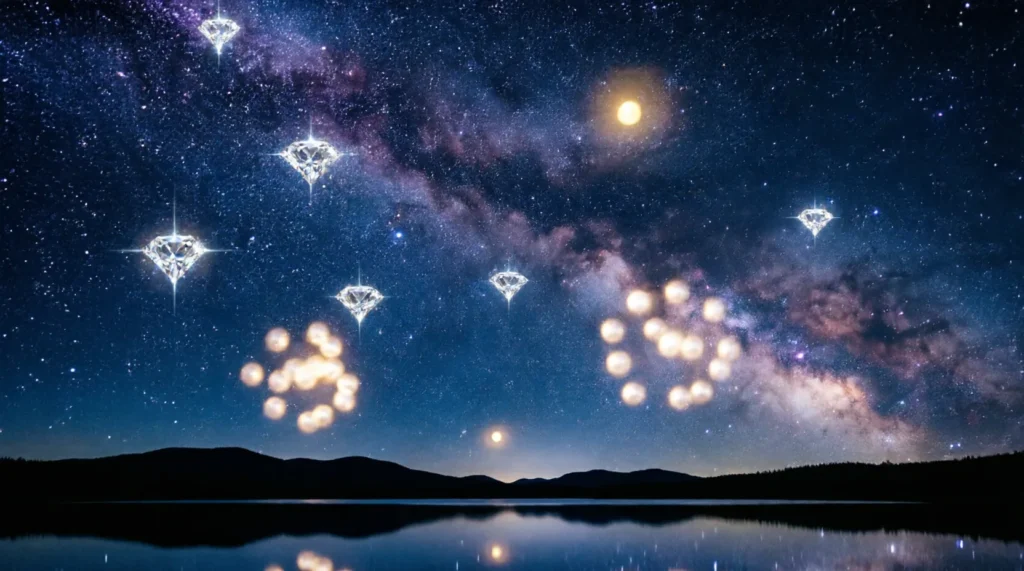
When you’re searching for the perfect way to describe the night sky, similes for stars in the sky give your readers an instant visual anchor they can grasp. The comparisons below span romantic, scientific, and everyday contexts—each one tested in my classroom to ensure it actually works on the page. Use them as-is in your poems, stories, or essays, or let them spark your own original comparisons.
Romantic and Dreamy Similes
These similes work beautifully in love letters, wedding vows, and lyrical poetry where you want to evoke wonder and intimacy.
“like diamonds scattered across black velvet” — “Her eyes reflected the night sky, like diamonds scattered across black velvet.” (luxurious, timeless) — This one endures because it pairs preciousness with softness; the hard sparkle of diamonds against velvet’s plush darkness creates tactile contrast your reader can feel.
“as constant as a lover’s promise” — “He watched the North Star, as constant as a lover’s promise.” (devotional, reassuring)
“like wishes waiting to be made” — “The stars hung above us like wishes waiting to be made.” (hopeful, anticipatory)
“as numerous as grains of sand on an endless shore” — “She tried to count them, as numerous as grains of sand on an endless shore.” (overwhelming, infinite)
“like scattered pearls on midnight silk” — “The constellation appeared like scattered pearls on midnight silk.” (elegant, refined) — I always tell my students this works because “pearls” suggests both value and organic irregularity, while “silk” implies luxury without being as heavy as “velvet.”
“as bright as hope in a dark time” — “That single star burned as bright as hope in a dark time.” (inspirational, emotional)
“like forgotten dreams floating upward” — “The faint stars glimmered like forgotten dreams floating upward.” (melancholic, wistful)
“as enchanting as a first kiss” — “The starlit sky was as enchanting as a first kiss.” (magical, intimate)
Brilliant and Radiant Similes
Use these when you need to emphasize the intense brightness, brilliance, or overwhelming visual impact of stars.
“like a billion candles lit at once” — “The meteor shower exploded like a billion candles lit at once.” (spectacular, overwhelming)
“as brilliant as a spotlight on opening night” — “Venus shone as brilliant as a spotlight on opening night.” (theatrical, commanding)
“like molten silver poured across the dark” — “The Milky Way stretched like molten silver poured across the dark.” (fluid, metallic) — This simile succeeds because “molten” suggests both heat and movement, transforming static stars into something alive and flowing.
“as sharp as a diamond’s edge” — “The star’s light cut through the fog as sharp as a diamond’s edge.” (piercing, precise)
“like electric sparks in a storm” — “The stars flickered like electric sparks in a storm.” (energetic, volatile)
“as dazzling as a fireworks finale” — “The supernova burned as dazzling as a fireworks finale.” (celebratory, explosive)
“like shards of brilliant glass” — “The ice crystals reflected the stars like shards of brilliant glass.” (fragmented, crystalline)
“as incandescent as a filament about to burn out” — “That dying star glowed as incandescent as a filament about to burn out.” (intense, tragic)
Distant and Remote Similes
These capture the unreachable, faraway quality of stars—perfect for themes of longing, isolation, or the vastness of space. According to Stars, these celestial bodies exist at distances that challenge human comprehension, making them natural symbols for the unattainable.
“like memories from another lifetime” — “Those stars seemed like memories from another lifetime.” (nostalgic, unreachable)
“as far away as yesterday’s regrets” — “Her dreams felt as far away as yesterday’s regrets.” (melancholic, resigned)
“like whispers from the edge of the universe” — “The faint glow arrived like whispers from the edge of the universe.” (mysterious, ancient)
“as remote as a stranger’s thoughts” — “The star’s secrets remained as remote as a stranger’s thoughts.” (unknowable, alien)
“like postcards from places you’ll never visit” — “Each constellation arrived like postcards from places you’ll never visit.” (wistful, touristic)
“as unreachable as perfect happiness” — “That ideal seemed as unreachable as perfect happiness.” (philosophical, yearning) — I warn my students this one borders on cliché, but it works when you need to convey cosmic-scale impossibility without being too on-the-nose.
“like echoes from a dead civilization” — “The light traveled like echoes from a dead civilization.” (haunting, archaeological)
“as detached as a god’s indifference” — “The stars burned as detached as a god’s indifference.” (cold, existential)
Twinkling and Dynamic Similes
Stars rarely sit still in our perception—they flicker, dance, and shift. These similes capture that movement and instability.
“like a nervous child’s heartbeat” — “The star pulsed like a nervous child’s heartbeat.” (anxious, fragile)
“as erratic as a faulty neon sign” — “The variable star blinked as erratic as a faulty neon sign.” (urban, unreliable)
“like fireflies trapped in amber” — “The distant lights shimmered like fireflies trapped in amber.” (preserved, golden)
“as playful as a kitten chasing shadows” — “The stars danced as playful as a kitten chasing shadows.” (whimsical, lighthearted)
“like a Morse code message from deep space” — “The pulsar sent signals like a Morse code message from deep space.” (communicative, coded)
“as restless as a caged bird” — “That star trembled as restless as a caged bird.” (confined, desperate)
“like sugar crystals dissolving on the tongue” — “The starlight melted like sugar crystals dissolving on the tongue.” (sweet, vanishing) — This is the version my students always reach for first when describing starlight on water; it works because it engages taste, not just sight, creating synesthetic richness.
“as jittery as a hummingbird’s wings” — “The light flickered as jittery as a hummingbird’s wings.” (rapid, delicate)
Guiding and Hopeful Similes
Throughout human history, stars have served as navigational tools and symbols of direction. These similes lean into that functional, reassuring quality.
“like a lighthouse for lost souls” — “The North Star stood like a lighthouse for lost souls.” (protective, directional)
“as reliable as an old friend’s advice” — “That constant star burned as reliable as an old friend’s advice.” (trustworthy, familiar)
“like a compass needle finding true north” — “Her purpose aligned like a compass needle finding true north.” (decisive, clarifying)
“as steady as a mother’s hand” — “The guiding light remained as steady as a mother’s hand.” (nurturing, stable)
“like breadcrumbs leading home” — “The stars formed a path like breadcrumbs leading home.” (nostalgic, reassuring)
“as dependable as the sunrise” — “That star rose as dependable as the sunrise.” (cyclical, certain)
“like a promise kept across decades” — “The star’s return felt like a promise kept across decades.” (faithful, enduring) — I tell writers this one avoids sentimentality by grounding abstraction in time; “decades” suggests human scale against cosmic permanence.
“as constant as your own pulse” — “The rhythm of the heavens proved as constant as your own pulse.” (intimate, biological)
Ancient and Timeless Similes
Stars connect us to deep time—the light we see tonight may have begun its journey before human civilization existed. These similes emphasize that staggering timescale.
“like elders watching over generations” — “The constellations loomed like elders watching over generations.” (wise, supervisory)
“as old as the concept of time itself” — “Those photons were as old as the concept of time itself.” (primordial, philosophical)
“like fossils of light” — “We observed them like fossils of light.” (archaeological, preserved)
“as ancient as the first breath” — “The starlight felt as ancient as the first breath.” (origin-story, elemental)
“like witnesses to every human story” — “They hung there like witnesses to every human story.” (omniscient, judgmental)
“as timeless as a mountain’s silence” — “The stars endured as timeless as a mountain’s silence.” (patient, monumental)
“like ghosts of suns long dead” — “We saw them like ghosts of suns long dead.” (haunting, posthumous) — This simile hits hard because it confronts the reader with the delay inherent in starlight; according to Simile, effective comparisons reveal truth through unexpected pairing, and “ghosts” paired with “suns” achieves exactly that.
“as permanent as stone carved with names” — “Their positions seemed as permanent as stone carved with names.” (monumental, memorial)
How to Write Your Own Stars in the Sky Simile
Creating original similes for stars requires you to move beyond the obvious “like diamonds” comparisons. Here’s my three-step process that I use in every workshop:
Step 1: Identify the specific quality you want to highlight. Is it the distance? The brightness? The emotional resonance? The scientific reality? Don’t try to capture everything at once.
Step 2: Brainstorm objects or experiences from an entirely different domain that share that quality. If you’re focusing on distance, don’t think of other space things—think of emotional distance, temporal distance, or social distance instead.
Step 3: Test the comparison by reading it aloud. If it sounds like something you’ve heard before, push further. The best similes create a small moment of surprise followed by immediate recognition.
Worked example: Let’s say I want to describe stars that appear and disappear behind clouds. Instead of “like shy children” (too common), I’ll think about what else appears and disappears unpredictably. What about “like a bad Wi-Fi signal”? That’s unexpected but instantly recognizable. “The stars flickered in and out like a bad Wi-Fi signal.” It’s modern, slightly frustrating, and captures that intermittent quality perfectly.
Frequently Asked Questions
What makes a star simile effective versus clichéd? An effective simile creates a fresh connection your reader hasn’t heard a thousand times. “Like diamonds” has been done to death—unless you’re subverting it or placing it in an unexpected context, skip it. The strongest similes pair stars with something from an entirely different sensory domain or emotional experience, creating that spark of recognition that makes readers pause and say, “Yes, that’s exactly what it’s like.”
Can I mix scientific accuracy with poetic similes? Absolutely, and you should. Some of the most powerful star similes acknowledge the actual physics—light traveling for years, stars being dead by the time we see them, the nuclear fusion at their cores. These scientific realities are inherently poetic. “Like messages from the dead” works because it’s both emotionally resonant and astronomically accurate for many stars.
How do I choose between romantic and scientific similes? Match the simile to your piece’s overall tone and purpose. A wedding vow needs “like scattered pearls,” while a hard science fiction story demands “like fusion reactors scattered across the void.” Don’t mix registers within the same paragraph unless you’re deliberately creating tonal dissonance for effect. Know your audience and your genre.
Should I use multiple star similes in one piece? Use restraint. One truly original, well-placed simile is worth more than five mediocre ones. If you’re writing a longer piece, vary your comparisons—don’t describe every star as “like” something. Sometimes just naming the star or describing its actual behavior is more powerful than any comparison you could construct.

Ashley Moore, a passionate educator with a knack for storytelling, holds a Bachelor’s degree in Creative Writing from the University of Iowa. With a career spanning over a decade, Ashley has worked extensively as a writing coach and a literature curriculum developer. Her fascination with similes and their ability to paint vivid mental images has been a driving force in her career. Ashley believes that figurative language is the bridge between mundane communication and imaginative expression. On SimileCraft, she writes in-depth guides that demystify the use of similes and metaphors in writing, empowering budding authors to tap into their creative potential. Her interactive workshops and tutorials are crafted to inspire confidence in writers of all levels, as she aims to bring the excitement of figurative language to a broader audience.