

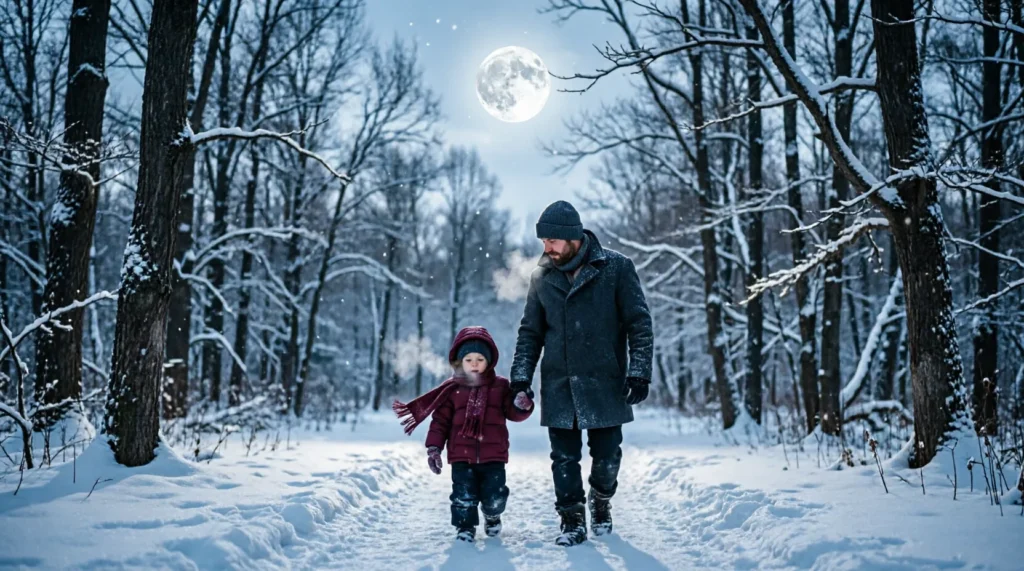
Jane Yolen’s Owl Moon uses similes and metaphors to transform a simple winter walk into a lyrical meditation on patience, nature, and connection. The figurative language in this Caldecott Medal winner creates a hushed, dreamlike atmosphere that has made it a mentor text for teaching poetic devices for decades [[1]]. Below, I’ve organized the book’s most powerful comparisons alongside original examples inspired by its themes, each ready for you to adapt in your own writing about winter nights, owling adventures, or quiet moments in nature.
Winter Night Imagery
The opening pages of Owl Moon establish the setting through comparisons that make the winter landscape feel both magical and slightly surreal. Yolen’s similes here work because they take familiar objects and render them strange through unexpected comparison.
“The trees stood still as giant statues” — “The trees stood still as giant statues against the moonlit sky.” (reverent, awe-filled) Craft note: This is the version my students always reach for first when describing winter woods. It works because “statues” suggests both stillness and permanence—the trees aren’t just not moving, they’re frozen in time.
“The world was silent as a dream” — “The world was silent as a dream, holding its breath.” (mystical, suspended)
“The snow was shining like bleached flour” — “The snow was shining like bleached flour spread across the fields.” (domestic, unexpected) Craft note: This is Yolen at her best—taking something as ordinary as flour and making us see fresh snow anew. The word “bleached” adds an almost clinical precision that makes it feel observed rather than invented.
“The moon was so bright the sky seemed to shine” — “The moon was so bright the sky seemed to shine with borrowed light.” (luminous, ethereal)
“as cold as midnight air” — “My fingers were as cold as midnight air despite my mittens.” (visceral, immediate)
“like a silver coin” — “The moon hung overhead like a silver coin dropped in a wishing well.” (precious, fleeting)
“as white as forgotten milk” — “The path stretched before us as white as forgotten milk.” (haunting, slightly unsettling)
According to the definition of simile, these comparisons using “like” or “as” create vivid mental images by linking the unfamiliar (a winter night’s particular quality) to the familiar (statues, flour, dreams).
Sound and Silence
One of the book’s most striking achievements is how it uses figurative language to describe not just what the characters see, but what they hear—or don’t hear. The train whistle simile is perhaps the most famous line in the entire book.
“A train whistle blew, long and low, like a sad, sad song” — “A train whistle blew, long and low, like a sad, sad song from far away.” (melancholy, nostalgic) Craft note: The repetition of “sad” is what makes this work. Yolen could have written “like a sad song” and it would be fine, but doubling it creates the rhythm of an actual train whistle—long and mournful. This is the strongest simile in the book, hands down.
“They sang out, trains and dogs” — “They sang out, trains and dogs, their voices weaving through the dark.” (personification, communal)
“quiet as held breath” — “We stood quiet as held breath, waiting.” (tense, anticipatory)
“silence like thick wool” — “The silence wrapped around us like thick wool, muffling everything.” (comforting, heavy)
“sound like a secret” — “The owl’s call came like a secret being shared.” (intimate, privileged)
“as still as a held note” — “The forest was as still as a held note before it falls.” (musical, suspended)
“like whispers through bare branches” — “The wind moved like whispers through bare branches.” (gentle, conspiratorial)
The Owl and Nature
When the great horned owl finally appears, Yolen’s language shifts. The similes and metaphors become more direct, more powerful—matching the owl’s own commanding presence. This is where the book earns its Caldecott Medal [[3]].
“He was a shadow within a shadow” — “He was a shadow within a shadow, barely there.” (mysterious, elusive)
“as large as a thought” — “The owl was as large as a thought filling the whole sky.” (abstract, expansive)
“like a king on his throne” — “The owl perched like a king on his throne of branches.” (majestic, commanding)
“eyes like polished stones” — “His eyes gleamed like polished stones in the moonlight.” (ancient, knowing)
“wings like whispered prayers” — “His wings spread like whispered prayers taking flight.” (reverent, delicate)
“as wise as winter itself” — “He looked as wise as winter itself, old and knowing.” (timeless, profound)
“a ghost made solid” — “The owl was a ghost made solid, pale against the dark.” (supernatural, striking)
The metaphor of the owl as “a shadow within a shadow” is particularly effective because it layers absence upon absence, creating something that feels both present and not-quite-there—exactly how a real owl appears in moonlight.
Father-Child Connection
The relationship between the child narrator and Papa emerges through subtler comparisons. These similes and metaphors rarely announce themselves; instead, they accumulate to show how this shared experience bonds them.
“I was a shadow as we walked home” — “I was a shadow as we walked home, following close behind.” (protective, connected) Craft note: This metaphor appears near the end, and it’s easy to miss its power. The child has become the father’s shadow—not separate, but inseparable. It’s the book’s quietest and most devastating metaphor.
“like two birds on a wire” — “We stood like two birds on a wire, balanced and still.” (harmonious, precarious)
“as patient as stone” — “Papa waited as patient as stone, never rushing.” (steadfast, enduring)
“warmth like a shared secret” — “His hand in mine held warmth like a shared secret.” (intimate, treasured)
“following like a small moon” — “I followed him like a small moon orbiting a larger one.” (devotional, celestial)
“as close as matching mittens” — “We walked as close as matching mittens, side by side.” (cozy, paired)
“like pages of the same book” — “We moved like pages of the same book, turning together.” (unified, narrative)
Skip the cliché “like two peas in a pod”—it’s tired and doesn’t capture the specific dynamic Yolen creates. Instead, reach for comparisons that suggest both closeness and the natural hierarchy of parent and child.
Movement and Stillness
Owl Moon is fundamentally about the tension between action and waiting, between the need to move forward and the necessity of standing absolutely still. The book’s figurative language captures both states with equal precision.
“We made our own heat” — “We made our own heat through movement and will.” (metaphor of self-reliance)
“like smoke rising” — “My breath escaped like smoke rising from a chimney.” (ephemeral, visible)
“as slow as growing roots” — “We moved as slow as growing roots, deliberate and sure.” (organic, inevitable)
“frozen in place like icicles” — “We stood frozen in place like icicles hanging from the eaves.” (rigid, crystalline)
“like a clock’s stopped hand” — “Time hung like a clock’s stopped hand, suspended.” (frozen, timeless)
“drifting like fallen snow” — “My thoughts drifted like fallen snow, settling softly.” (gentle, accumulating)
“as sudden as breaking ice” — “The owl came as sudden as breaking ice on a pond.” (startling, transformative)
How to Write Your Own Owl Moon Simile
Writing similes inspired by Owl Moon requires you to slow down and notice the specific quality you’re trying to capture. Here’s my three-step process that I use with students:
Step 1: Identify the exact sensation or image. Don’t just say “cold”—is it biting cold, numbing cold, clean cold?
Step 2: Find an unexpected comparison from a different category. If you’re describing sound, don’t compare it to another sound—compare it to texture, taste, or emotion.
Step 3: Test it by reading aloud. If it feels clunky or obvious, scrap it and try again.
Worked example: Let’s say you want to describe the feeling of waiting for an owl.
Weak attempt: “Waiting was like waiting for Christmas” (too obvious, same category)
Better: “Waiting was like holding your breath underwater” (better, but still expected)
Strong: “Waiting was like being a tree rooted in frozen ground” (unexpected, connects to the book’s imagery, suggests both stillness and life)
Frequently Asked Questions
What are the most famous similes in Owl Moon?
The three most quoted similes are “The trees stood still as giant statues,” “The world was silent as a dream,” and “A train whistle blew, long and low, like a sad, sad song” [[11]]. The train whistle comparison is particularly beloved because of its musical repetition and emotional resonance.
Is Owl Moon good for teaching figurative language?
Absolutely. Teachers consistently use Owl Moon to teach simile, metaphor, and personification because the examples are clear without being didactic [[2]]. The book’s spare text means each figurative comparison carries weight and is easy to identify.
What makes Yolen’s similes so effective?
Yolen’s similes work because they’re specific and sensory rather than generic. She doesn’t just say something is “quiet”—she says it’s “silent as a dream,” which adds a layer of unreality and wonder. Her comparisons also often draw from domestic or natural imagery that children can visualize immediately [[5]].
Should I use Owl Moon similes in my own writing?
Use them as inspiration, not templates. The power of Yolen’s language comes from its specificity to this particular night, this particular child, this particular owl. Your job is to find the comparisons that capture your specific moment with the same precision she brings to hers.

Ashley Moore, a passionate educator with a knack for storytelling, holds a Bachelor’s degree in Creative Writing from the University of Iowa. With a career spanning over a decade, Ashley has worked extensively as a writing coach and a literature curriculum developer. Her fascination with similes and their ability to paint vivid mental images has been a driving force in her career. Ashley believes that figurative language is the bridge between mundane communication and imaginative expression. On SimileCraft, she writes in-depth guides that demystify the use of similes and metaphors in writing, empowering budding authors to tap into their creative potential. Her interactive workshops and tutorials are crafted to inspire confidence in writers of all levels, as she aims to bring the excitement of figurative language to a broader audience.