

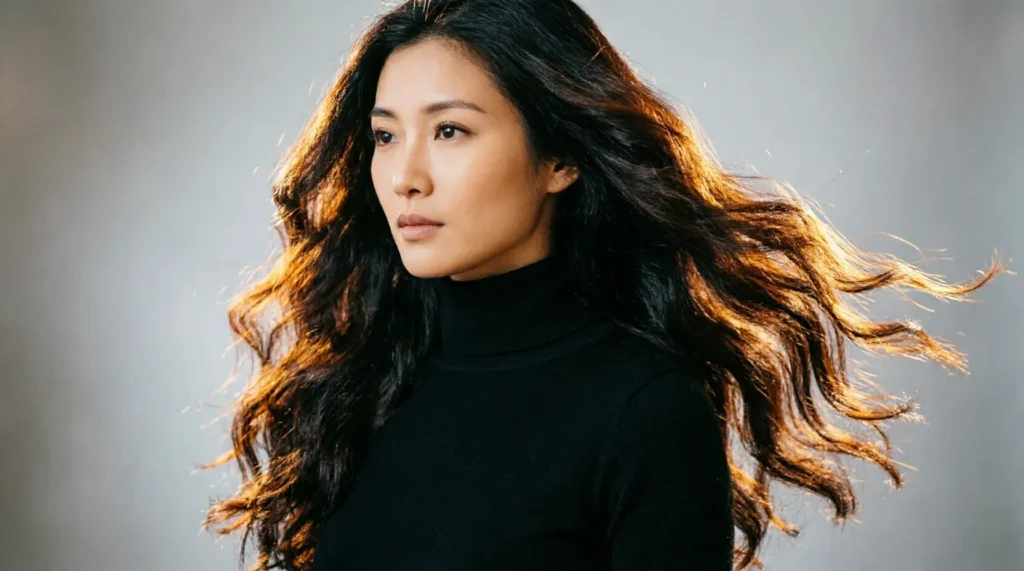
Hair is one of the most expressive features we have, and finding the right words to capture its character can transform flat description into something readers actually feel. The similes below are organized by texture, movement, and mood so you can drop them straight into your scenes, poems, or personal essays. Each one comes with a real example sentence and a quick tone note so you know exactly when to use it.
Similes for Silky, Smooth Hair
These comparisons work when you’re describing hair that flows effortlessly, catches light beautifully, or feels luxurious to the touch. They’re perfect for romantic scenes, character introductions, or moments when you want to emphasize grace.
“as smooth as poured silk” — “Her hair fell down her back as smooth as poured silk.” (elegant, refined)
“like a waterfall of dark honey” — “In the sunlight, his hair looked like a waterfall of dark honey.” (warm, admiring) Craft note: This one works because it layers two sensory details—movement (waterfall) and color/texture (honey)—creating a richer image than either alone.
“as sleek as a seal’s coat” — “After her shower, her hair was as sleek as a seal’s coat.” (polished, modern)
“like spun glass” — “Her blonde hair caught the light like spun glass.” (delicate, almost fragile)
“as straight as a ruler’s edge” — “His hair fell as straight as a ruler’s edge, not a strand out of place.” (precise, controlled)
“like liquid obsidian” — “Her black hair flowed like liquid obsidian, dark and gleaming.” (dramatic, intense) Craft note: The alliteration in “liquid” and the unexpected mineral comparison make this feel fresh rather than clichéd.
“as soft as a kitten’s fur” — “She ran her fingers through hair as soft as a kitten’s fur.” (tender, intimate)
“like a curtain of midnight” — “He pulled back hair like a curtain of midnight to reveal her face.” (theatrical, mysterious)
Similes for Wild, Untamed Hair
Sometimes hair refuses to be tamed, and these similes capture that rebellious energy. Use them for characters who are free-spirited, chaotic, or just woke up like that.
“like a storm-tossed sea” — “After the wind died down, her hair still looked like a storm-tossed sea.” (dramatic, windswept)
“as wild as a bramble patch” — “His morning hair was as wild as a bramble patch.” (unkempt, humorous)
“like lightning frozen mid-strike” — “Her red hair stood up like lightning frozen mid-strike.” (electric, striking) Craft note: The specificity of “frozen mid-strike” rather than just “like lightning” gives this simile its punch—it captures a moment in time.
“as tangled as old fishing line” — “The toddler’s hair was as tangled as old fishing line.” (frustrated, realistic)
“like a bird’s nest after a gale” — “He ran his hands through hair like a bird’s nest after a gale.” (chaotic, slightly comedic)
“as untamed as a mustang’s mane” — “Her curls bounced as untamed as a mustang’s mane.” (free, powerful)
“like static-charged wool” — “In the dry winter air, his hair stood up like static-charged wool.” (playful, relatable)
“as messy as a teenager’s bedroom” — “She gave up on her hair, letting it stay as messy as a teenager’s bedroom.” (resigned, casual)
Similes for Curly and Coiled Hair
Curly hair has its own language of movement and texture. These similes celebrate spirals, ringlets, and coils with specificity and respect.
“like a galaxy of tight spirals” — “Her afro was like a galaxy of tight spirals, each one catching the light differently.” (celebratory, expansive)
“as bouncy as a slinky” — “His curls were as bouncy as a slinky, springing back with every step.” (playful, energetic)
“like coiled springs” — “Her hair bounced like coiled springs when she laughed.” (lively, joyful)
“as defined as calligraphy” — “Each ringlet was as defined as calligraphy, perfect and deliberate.” (artistic, precise) Craft note: Comparing hair to calligraphy elevates it to an art form—the kind of unexpected pairing that makes readers pause and see something familiar in a new way.
“like a crown of cinnamon rolls” — “Her daughter’s curls looked like a crown of cinnamon rolls, sweet and golden.” (affectionate, whimsical)
“as tight as barbed wire” — “His hair grew in as tight as barbed wire, coarse and unforgiving.” (harsh, textured)
“like ocean waves in miniature” — “Her finger waves looked like ocean waves in miniature, sculpted and gleaming.” (vintage, elegant)
“as springy as a poodle’s coat” — “The humidity made her hair as springy as a poodle’s coat.” (humorous, observational)
Similes for Shiny, Lustrous Hair
When hair catches light or looks healthy and vibrant, these similes help you show rather than tell that radiance. According to Wikipedia’s entry on simile, the power of comparison lies in making the unfamiliar familiar—or the familiar newly visible.
“like polished mahogany” — “His hair gleamed like polished mahogany in the firelight.” (rich, warm)
“as glossy as a raven’s wing” — “Her black hair was as glossy as a raven’s wing.” (classic, darkly beautiful)
“like molten copper” — “In the sunset, her auburn hair looked like molten copper.” (fiery, transformative)
“as radiant as a halo” — “The backlight made her hair as radiant as a halo.” (angelic, ethereal)
“like freshly varnished wood” — “His slicked-back hair shone like freshly varnished wood.” (sleek, possibly artificial)
“as lustrous as pearl” — “Her silver hair was as lustrous as pearl, catching every bit of light.” (sophisticated, age-positive) Craft note: This simile works against the grain of typical “gray hair” descriptions, treating silver as precious rather than something to apologize for.
“like a sheet of satin” — “Her straight hair fell like a sheet of satin, without a single snag.” (luxurious, smooth)
“as gleaming as wet stone” — “After the rain, his dark hair looked as gleaming as wet stone.” (natural, elemental)
Similes for Thin or Fine Hair
Not all hair is thick and luxurious, and these similes handle delicate, sparse, or thinning hair with honesty and sometimes tenderness. The goal when you describe something accurately is to serve the truth of the character, not just the pretty version.
“as fine as corn silk” — “Her baby-fine hair was as fine as corn silk, barely there.” (delicate, gentle)
“like wisps of smoke” — “His thinning hair floated like wisps of smoke, barely clinging to his scalp.” (melancholy, fading)
“as sparse as winter grass” — “The top of his head was as sparse as winter grass.” (blunt, unsparing)
“like gossamer thread” — “Her translucent hair hung like gossamer thread, catching the light but offering no warmth.” (ethereal, fragile)
“as thin as rice paper” — “His hair lay against his skull as thin as rice paper.” (vulnerable, exposed)
“like a fading photograph” — “Her once-thick hair was now like a fading photograph, the details softening with time.” (nostalgic, tender) Craft note: This simile does double duty—it describes the physical thinning while also evoking memory and the passage of time, which is often what we’re really talking about with aging hair.
“as light as dandelion fluff” — “The child’s hair was as light as dandelion fluff, lifting with every breeze.” (innocent, airy)
“like a shadow of its former self” — “His hair was like a shadow of its former self, present but insubstantial.” (wistful, resigned)
Similes for Thick, Heavy Hair
When hair has weight, volume, or presence, these comparisons capture that abundance. They work for everything from admiration to exhaustion.
“as thick as a horse’s tail” — “Her braid was as thick as a horse’s tail, heavy and impressive.” (robust, rural)
“like a lion’s mane” — “His curly hair framed his face like a lion’s mane, wild and commanding.” (majestic, powerful)
“as heavy as a wool blanket” — “In the humidity, her hair felt as heavy as a wool blanket.” (burdensome, uncomfortable)
“like a tapestry” — “Her braided hair hung like a tapestry, intricate and substantial.” (artistic, cultural)
“as dense as a forest canopy” — “His hair was as dense as a forest canopy, impossible to see through.” (impenetrable, overwhelming)
“like a waterfall in full flood” — “When she let her hair down, it cascaded like a waterfall in full flood.” (dramatic, abundant)
“as voluminous as a Victorian curtain” — “Her teased hair was as voluminous as a Victorian curtain, all drama and height.” (theatrical, possibly excessive)
“like a mountain of dark clouds” — “His hair piled on his head like a mountain of dark clouds.” (imposing, stormy)
How to Write Your Own Hair Simile
Creating fresh hair similes isn’t about finding the most obscure comparison—it’s about matching the hair’s actual qualities to something unexpected but recognizable. Here’s my three-step process that I teach in every workshop:
Step 1: Identify the dominant quality. Is it the texture (silky, coarse), the movement (flowing, bouncing), the weight (heavy, light), or the visual effect (shiny, dull)?
Step 2: Brainstorm objects or phenomena that share that quality but come from a different category. If you’re describing movement, don’t just think of other hair—think of water, fabric, animals, weather.
Step 3: Test for specificity. “Like silk” is tired. “Like silk just pulled from the bolt” has more texture. Add one concrete detail that makes it yours.
Worked example: Let’s say you’re describing hair that’s frizzy from humidity. Dominant quality: expansion, loss of control. Brainstorm: popcorn, exploding stars, dandelions going to seed, bread rising. Specific detail: the moment of transformation. Final simile: “Her hair expanded like bread dough in a warm kitchen, growing beyond all expectations.”
Frequently Asked Questions
What makes a hair simile effective versus clichéd?
An effective hair simile surprises the reader while remaining instantly understandable. “Hair like silk” is clichéd because it’s been used so often it’s lost its impact. “Hair like silk just pulled from a river stone” gives the reader something new to visualize. The difference is specificity and freshness.
Can I mix positive and negative qualities in one hair simile?
Absolutely, and often you should. Real hair is complicated, and so are the people it belongs to. “Her hair was as beautiful as a storm cloud—dark, dramatic, and impossible to ignore” captures both admiration and warning. This complexity makes characters feel real.
How do I describe hair without relying on color alone?
Focus on movement, texture, weight, sound, and how it interacts with the environment. Instead of “brown hair,” try “hair that moved like wheat in a breeze” or “hair as coarse as burlap.” Color is one dimension; these similes give you depth, motion, and tactile sensation.
Are there similes I should avoid for cultural sensitivity?
Yes. Avoid similes that exoticize or fetishize hair textures associated with specific ethnic groups, or that use animal comparisons that have historically been used as racial slurs. When in doubt, ask yourself: am I describing this hair with the same respect I’d give any other feature, or am I “othering” it? Stick to comparisons that celebrate rather than diminish.

Brandon Robinson is a literary enthusiast and seasoned editor with a deep-rooted passion for figurative language and its transformative power in storytelling. He completed his Ph.D. in Linguistics from the University of Chicago, specializing in the cognitive impact of metaphors and similes in narrative construction. With over 18 years in the publishing industry, Brandon has helped shape numerous literary works by providing his expertise in metaphorical nuance and creative expression. His journey into the world of similes began when a high school poetry class opened his eyes to the elegance of figurative comparisons. At SimileCraft, Brandon writes thought-provoking essays that explore the cognitive science behind similes, while also curating content that inspires writers to use these tools more effectively. His pieces are a blend of scholarly insight and practical advice, tailored for an audience eager to deepen their literary skills.