

Shakespeare’s Macbeth contains some of the most powerful metaphors for death in all of literature, transforming mortality into vivid images that resonate centuries later. These metaphors don’t just describe death—they make you feel its weight, its suddenness, and its inevitable pull. Below, you’ll find the play’s most striking death imagery organized by theme, each shown in context so you can understand how Shakespeare deployed these metaphors to maximum dramatic effect.
The “Tomorrow” Soliloquy: Life as Fleeting Shadow
When Macbeth learns of Lady Macbeth’s death, he delivers one of literature’s most famous meditations on mortality. This speech layers metaphor upon metaphor to convey life’s meaninglessness.
“Life’s but a walking shadow” — “Life’s but a walking shadow, a poor player that struts and frets his hour upon the stage.” (existential, nihilistic) — This metaphor works because it combines insubstantiality (“shadow”) with false animation (“walking”), suggesting we’re mere illusions of life rather than truly alive.
“A poor player that struts and frets” — “Out, out, brief candle! Life’s but a walking shadow, a poor player that struts and frets his hour upon the stage.” (theatrical, dismissive) — The theatrical metaphor reduces human existence to bad acting, emphasizing performance over substance.
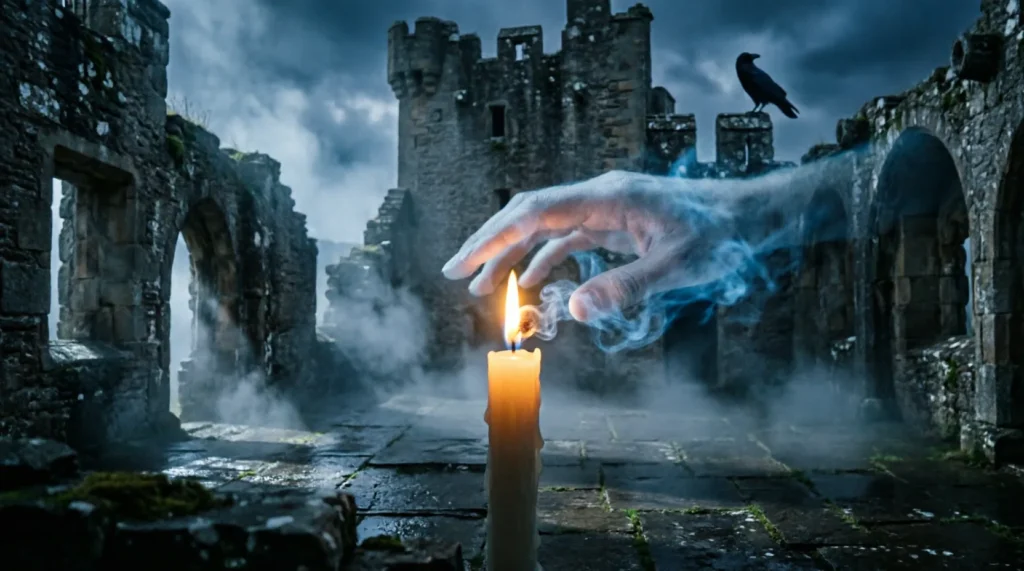
“Brief candle” — “Out, out, brief candle!” (sudden, fragile) — I tell my students this is the version Shakespeare’s audience would have felt viscerally: candles were everyday objects that could be snuffed instantly, making death’s suddenness tangible.
“Told by an idiot, full of sound and fury” — “It is a tale told by an idiot, full of sound and fury, signifying nothing.” (chaotic, meaningless) — The metaphor of life as a badly-told story suggests not just meaninglessness but active incoherence.
“Signifying nothing” — “It is a tale told by an idiot, full of sound and fury, signifying nothing.” (hollow, empty) — This isn’t strictly a metaphor but functions as one: existence as zero, as void.
“His hour upon the stage” — “A poor player that struts and frets his hour upon the stage and then is heard no more.” (time-limited, performative) — The theatrical metaphor emphasizes both brevity and artificiality.
According to ThoughtCo’s analysis of Shakespeare’s death quotes, this soliloquy represents “one of the most profound expressions of existential despair in Western literature,” and these metaphors remain the play’s most quoted death imagery.
Lady Macbeth’s Death: Sleep and Finality
Lady Macbeth’s death is reported rather than shown, but the metaphors surrounding it emphasize sleep as death’s twin.
“The queen, my lord, is dead” — “The queen, my lord, is dead.” (matter-of-fact, stark) — The simplicity here is itself a kind of metaphor: death as the ultimate reduction of language.
“She should have died hereafter” — “She should have died hereafter; there would have been a time for such a word.” (ill-timed, inevitable) — This isn’t a metaphor but treats death as something that arrives on its own schedule, not ours.
“Out, out, brief candle!” — “Out, out, brief candle!” (extinguished, fragile) — Though part of the “Tomorrow” speech, this directly responds to news of her death, making her life the candle snuffed.
“The way to dusty death” — While this phrase appears in Hamlet, Macbeth’s treatment of death similarly emphasizes dust and return to earth. (earthy, returning)
“Sleep that knits up the ravell’d sleeve of care” — Earlier in the play, sleep is metaphorically described as restorative, making Lady Macbeth’s “sleep” in death an ironic perversion. (ironic, perverted)
“In the sleep of death, no more” — The equation of death with eternal sleep runs throughout the play. (final, eternal)
Violent Death: Blood and Battle Imagery
Macbeth is saturated with violent death, and Shakespeare uses visceral metaphors to make battlefield mortality immediate.
“Unseam’d him from the nave to the chaps” — “Till he unseam’d him from the nave to the chaps, and fix’d his head upon our battlements.” (graphic, brutal) — This metaphor of unzipping a body makes death horrifyingly physical and mechanical.
“Bellona’s bridegroom” — Macbeth is called this, metaphorically married to the goddess of war, suggesting death as his spouse. (martial, destined)
“Valour’s minion” — Another metaphor for Macbeth as death’s servant or favorite. (servile, deadly)
“Carv’d out his passage” — “Till he carv’d out his passage till he faced the slave.” (sculptural, violent) — The metaphor of carving suggests both artistry and butchery.
“Smoked with bloody execution” — “And fix’d his head upon our battlements.” The sword metaphorically smokes from killing. (visceral, heated)
“Reeking wounds” — “Which smoked with bloody execution.” Wounds that steam with fresh blood. (fresh, horrifying)
“Disdainful fortune” — Battle death is attributed to fortune’s whims, a metaphorical force controlling mortality. (capricious, uncontrollable)
I always warn students away from overusing “valiant” or “brave” when describing battlefield death—Shakespeare’s strength is in the specific, physical details like “unseam’d” rather than generic praise.
Death as Sleep: The Great Equalizer
Throughout Macbeth, death is repeatedly metaphorized as sleep, creating both comfort and terror.
“The death of each day’s life, sore labour’s bath” — Sleep is described this way, making it a metaphorical rehearsal for death. (restorative, cleansing)
“Balm of hurt minds” — Sleep as healing ointment, which death permanently provides. (healing, final)
“Great nature’s second course” — Sleep as a second meal, death as the final feast. (natural, sustaining)
“Chief nourisher in life’s feast” — Sleep feeds life; death ends the feast entirely. (nourishing, ending)
“To die, to sleep” — This equation from Hamlet resonates in Macbeth as well. (equivalent, peaceful)
“Perchance to dream” — The fear that death-sleep might bring nightmares. (uncertain, troubling)
“In that sleep of death what dreams may come” — Death as dream-filled sleep. (mysterious, unsettling)
The sleep metaphor works so well because it’s universal—everyone understands sleep’s temporary oblivion, making permanent oblivion comprehensible through comparison.
Death’s Inevitability: Time and Fate
Shakespeare uses temporal metaphors to show death as unavoidable destination.
“The last syllable of recorded time” — Death as the final word in history. (final, historical)
“The fatal bellman” — The bellman who rings for executions, metaphorically summoning all to death. (summoning, official)
“The hour” — Repeated references to one’s “hour” of death as predetermined time. (predetermined, scheduled)
“Dusty death” — The return to earth, dust as death’s substance. (earthy, returning)
“The yesterdays that have lighted fools” — Past days leading inevitably to death’s candle’s end. (sequential, leading)
“Life’s fitful fever” — Existence as illness, death as cure or end. (sick, ending)
According to Wikipedia’s entry on William Shakespeare, his works consistently explore “the inevitability of death and the passage of time,” and Macbeth represents his most concentrated treatment of these themes.
How to Write Your Own Macbeth-Style Death Metaphor
Creating death metaphors in Shakespeare’s manner requires understanding his technique. Here’s my three-step process:
Step 1: Choose a concrete, everyday object or action. Shakespeare never uses abstract concepts to describe death—he uses candles, actors, sleep, dust, bells. Pick something your audience knows intimately.
Step 2: Identify one quality that object shares with death. A candle can be snuffed suddenly. An actor performs briefly then exits. Sleep temporarily suspends consciousness. Find the overlap.
Step 3: Compress the comparison into vivid language. Don’t say “death is like a candle going out.” Say “out, out, brief candle!” The compression creates power.
Worked example: Let’s create a new metaphor. Concrete object: a book. Shared quality: it has a final page, a closing. Compression: “Death is the last page no reader chooses.” Or better, more Shakespearean: “The final page, turn’d by no hand but time’s.”
Frequently Asked Questions
What is the most famous metaphor for death in Macbeth? “Life’s but a walking shadow” from the “Tomorrow” soliloquy is the most quoted, followed closely by “out, out, brief candle!” These metaphors capture life’s insubstantiality and fragility.
Why does Shakespeare compare death to sleep in Macbeth? Sleep serves as a metaphor for death because both involve unconsciousness and stillness. However, Shakespeare also uses this comparison to explore the terror that death might be sleep with dreams—unknown and potentially nightmarish.
How many death metaphors appear in Macbeth? While exact counts vary by interpretation, Macbeth contains over 30 distinct metaphorical treatments of death across its five acts, making it one of Shakespeare’s most death-obsessed plays.
What makes Macbeth’s death metaphors different from other Shakespeare plays? Macbeth uniquely combines violent, physical death imagery (unseaming, carving, reeking wounds) with existential, philosophical metaphors (shadows, candles, tales told by idiots). This duality reflects the play’s movement from physical battle to spiritual emptiness.

Ashley Moore, a passionate educator with a knack for storytelling, holds a Bachelor’s degree in Creative Writing from the University of Iowa. With a career spanning over a decade, Ashley has worked extensively as a writing coach and a literature curriculum developer. Her fascination with similes and their ability to paint vivid mental images has been a driving force in her career. Ashley believes that figurative language is the bridge between mundane communication and imaginative expression. On SimileCraft, she writes in-depth guides that demystify the use of similes and metaphors in writing, empowering budding authors to tap into their creative potential. Her interactive workshops and tutorials are crafted to inspire confidence in writers of all levels, as she aims to bring the excitement of figurative language to a broader audience.