

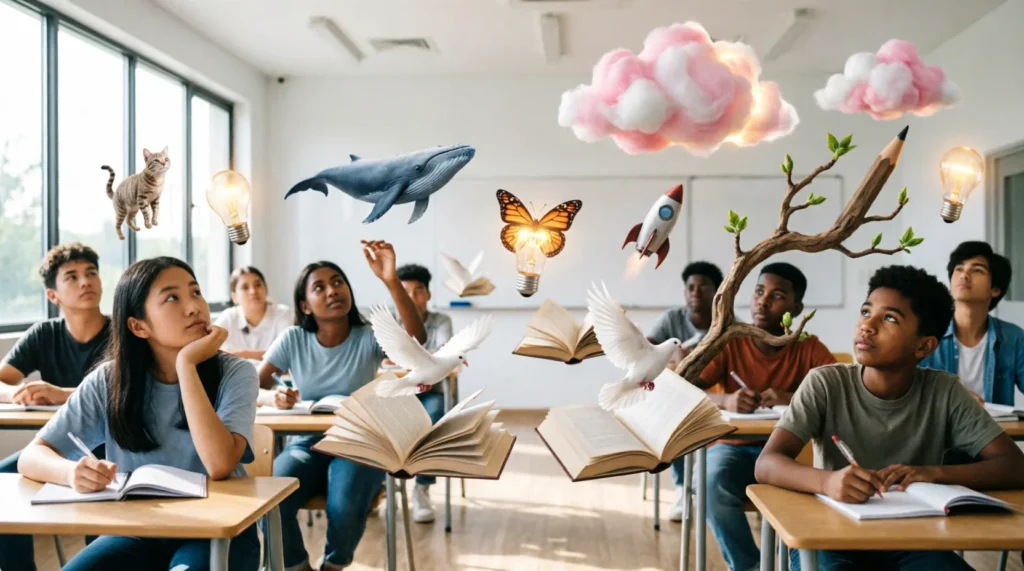
Similes are the most accessible entry point into figurative language, allowing students to bridge the gap between abstract feelings and concrete imagery using “like” or “as.” The 100 similes examples for students collected below are organized by emotional tone and sensory experience, providing ready-to-use sentences that demonstrate proper context rather than isolated phrases. Use this list as a reference bank when drafting narratives, analyzing poetry, or seeking a precise comparison that avoids tired clichés.
What Is a Simile?
A simile is a figure of speech that explicitly compares two unlike things using connecting words such as “like,” “as,” “so,” or “than” to create a vivid mental image or clarify an abstract concept. According to Simile, this rhetorical device has been foundational in literature and oral tradition for millennia because it allows speakers and writers to transfer the qualities of a familiar object onto something less tangible. Unlike a metaphor, which asserts that one thing is another (e.g., “time is a thief”), a simile maintains a degree of separation, acknowledging the comparison as an approximation rather than a literal identity. This distinction matters in student writing because similes often feel more natural in dialogue and descriptive exposition, whereas metaphors can sometimes sound overly declarative or poetic if not handled with care.
Similes for Emotions and Internal States
When students write about feelings, they often default to abstract labels like “sad” or “happy.” These similes ground those emotions in physical sensations, making the internal state visible to the reader. I always tell my creative writing classes that the best emotional similes bypass the brain and hit the body first.
- “as nervous as a cat in a room full of rocking chairs” — “He stood outside the principal’s office, as nervous as a cat in a room full of rocking chairs.” (humorous, relatable anxiety). This works because it replaces generic jitters with a specific, kinetic image of potential danger and hyper-vigilance.
- “happy as a clam at high tide” — “After receiving her acceptance letter, she was happy as a clam at high tide.” (content, safe joy). While some consider this folksy, its specificity makes it warmer than “happy as a lark,” which has lost all texture through overuse.
- “angry as a hornet whose nest was poked” — “The coach was angry as a hornet whose nest was poked when he saw the missed assignments.” (reactive, stinging fury). Avoid “mad as a wet hen”; the hornet image carries actual threat and consequence.
- “sad as a willow in winter” — “She sat by the window, sad as a willow in winter.” (quiet, enduring melancholy). The drooping branches provide a visual posture for grief that “blue” or “down” cannot convey.
- “excited as a puppy on Christmas morning” — “The freshmen were excited as a puppy on Christmas morning during orientation.” (uncontainable, youthful energy). Best used for younger characters or genuine innocence; for older students, try “buzzing like a live wire.”
- “confused as a tourist without a map” — “I stared at the calculus problem, confused as a tourist without a map.” (disoriented, helpless). This grounds intellectual frustration in a universal travel experience.
- “proud as a peacock in full plume” — “He walked across the stage, proud as a peacock in full plume.” (displayed, confident achievement). The key here is visibility; this simile describes pride that is meant to be seen, not private satisfaction.
- “lonely as a single sock in the dryer” — “After moving to a new city, he felt lonely as a single sock in the dryer.” (mundane, domestic isolation). This modern domestic image resonates more with contemporary students than pastoral clichés about lone wolves.
- “guilty as a dog who ate the homework” — “She avoided eye contact, guilty as a dog who ate the homework.” (sheepish, obvious culpability). A playful twist on the classic courtroom phrase, perfect for school-based narratives.
- “calm as a millpond at dawn” — “Despite the chaos, the nurse remained calm as a millpond at dawn.” (still, undisturbed peace). The temporal marker “at dawn” adds freshness to an otherwise traditional water comparison.
Similes for Physical Sensations and Appearance
Descriptive writing fails when it relies solely on adjectives. These comparisons anchor physical traits in observable reality, helping readers see, hear, and feel what the character experiences. As a teacher, I’ve found that students struggle most with describing faces and bodies without sounding clinical; these examples model how to keep descriptions human.
- “eyes bright as polished amber” — “Her eyes were bright as polished amber in the firelight.” (warm, luminous gaze). “Polished” does heavy lifting here—it implies both color and reflection, avoiding the deadness of “brown eyes.”
- “skin smooth as river stone” — “His grandmother’s hands were skin smooth as river stone from years of washing clothes.” (worn, gentle texture). This honors age and labor rather than erasing them with youthful beauty standards.
- “voice rough as gravel under tires” — “The narrator’s voice was rough as gravel under tires.” (abrasive, textured sound). Auditory similes are rare in student work; this one creates immediate sonic atmosphere.
- “hair wild as a storm-tossed kelp forest” — “She emerged from the ocean with hair wild as a storm-tossed kelp forest.” (chaotic, organic movement). Far more evocative than “messy hair,” this ties appearance directly to environment.
- “smile sharp as broken glass” — “His apology came with a smile sharp as broken glass.” (dangerous, deceptive warmth). This subverts the expected positivity of a smile, signaling threat beneath surface politeness.
- “hands steady as a surgeon’s scalpel” — “Even during the earthquake drill, her hands were steady as a surgeon’s scalpel.” (precise, controlled competence). Specificity of tool matters; “steady as a rock” tells us nothing about skill.
- “posture stiff as a starched collar” — “He sat through the lecture with posture stiff as a starched collar.” (uncomfortable formality). Clothing-based similes efficiently convey social tension and self-consciousness.
- “breath shallow as a hummingbird’s wingbeat” — “After sprinting up four flights, her breath was shallow as a hummingbird’s wingbeat.” (rapid, fragile respiration). Captures both speed and vulnerability in athletic exhaustion.
- “cheeks flushed as ripe peaches” — “Embarrassed, her cheeks were flushed as ripe peaches.” (soft, warm coloration). “Ripe” suggests natural ripeness rather than artificial rouge, keeping the tone tender.
- “gaze distant as fog over harbor water” — “During the memorial, his gaze was distant as fog over harbor water.” (obscured, unfocused attention). Perfect for scenes of dissociation or grief where the character is physically present but mentally elsewhere.
Similes for Academic and Intellectual Experiences
Students rarely get to describe their own learning lives with figurative language. These similes validate the intellectual journey as worthy of literary treatment, drawing from classroom realities rather than generic nature imagery. According to Student, the modern learner navigates complex systems of knowledge acquisition, assessment, and peer collaboration—all fertile ground for fresh comparison.
- “mind buzzing like a server farm at peak load” — “During finals week, her mind was buzzing like a server farm at peak load.” (overheated, processing overload). Updates the outdated “brain as computer” trope with contemporary tech infrastructure.
- “focus narrow as a laser pointer on a whiteboard” — “While editing his thesis, his focus was narrow as a laser pointer on a whiteboard.” (intense, directed concentration). Classroom-specific imagery makes academic effort feel embodied.
- “ideas tangled as headphones in a backpack” — “Her argument was ideas tangled as headphones in a backpack.” (frustratingly knotted logic). Every student knows this pain; it translates cognitive mess into tactile annoyance.
- “memory porous as a worn-out sponge” — “After three all-nighters, his memory was porous as a worn-out sponge.” (leaky, degraded retention). Honest about burnout without romanticizing suffering.
- “curiosity hungry as a stray cat at a dumpster” — “The transfer student asked questions with curiosity hungry as a stray cat at a dumpster.” (desperate, resourceful inquiry). Validates non-traditional learners’ drive without pity.
- “confidence fragile as unglazed pottery” — “Presenting her first research poster, her confidence was fragile as unglazed pottery.” (unfinished, easily cracked). Acknowledges that scholarly identity is still forming.
- “understanding dawning slow as sunrise over campus quad” — “The concept finally clicked, understanding dawning slow as sunrise over campus quad.” (gradual, illuminating clarity). Ties intellectual breakthrough to a shared student landscape.
- “fatigue heavy as a backpack full of textbooks” — “By Friday afternoon, her fatigue was heavy as a backpack full of textbooks.” (accumulated, burdensome weight). Makes exhaustion measurable through a universal student object.
- “insight sudden as a pop quiz answer” — “Mid-conversation, insight struck sudden as a pop quiz answer.” (unexpected, high-stakes realization). Captures the adrenaline of unplanned comprehension.
- “doubt persistent as a flickering fluorescent light” — “Throughout the semester, imposter syndrome lingered, doubt persistent as a flickering fluorescent light.” (annoying, ever-present distraction). Institutional lighting becomes metaphor for systemic insecurity.
Similes for Social Dynamics and Relationships
Peer interactions define much of student life, yet descriptions of friendship, conflict, and belonging often lack nuance. These similes capture the subtle textures of connection without reducing relationships to stereotypes. I emphasize in workshops that social similes should reveal power dynamics, not just label emotions.
- “friendship solid as oak roots beneath campus soil” — “Their friendship was solid as oak roots beneath campus soil.” (deep, unseen foundation). Celebrates longevity without sentimentality; roots imply mutual nourishment.
- “awkward silence thick as cafeteria mashed potatoes” — “The blind date had awkward silence thick as cafeteria mashed potatoes.” (starchy, suffocating discomfort). Humor defuses tension while accurately naming institutional food as cultural touchstone.
- “trust brittle as old library book binding” — “After the betrayal, their trust was brittle as old library book binding.” (aged, fragile history). Links relational damage to shared academic spaces.
- “laughter infectious as yawns in a lecture hall” — “Their laughter was infectious as yawns in a lecture hall.” (contagious, involuntary response). Uses collective student behavior to mirror social mimicry.
- “rivalry tense as two phones fighting for one charger” — “The debate team rivalry was tense as two phones fighting for one charger.” (resource-scarce competition). Modernizes conflict through tech scarcity familiar to every student.
- “loyalty steadfast as a study group before exams” — “Her loyalty was steadfast as a study group before exams.” (tested, reliable commitment). Grounds virtue in collaborative academic ritual.
- “betrayal cold as an empty dorm hallway at midnight” — “His betrayal felt cold as an empty dorm hallway at midnight.” (isolating, echoing absence). Spatial emptiness mirrors emotional abandonment.
- “admiration glowing as phone screens in a dark theater” — “Her admiration was glowing as phone screens in a dark theater.” (focused, illicit brightness). Captures secret appreciation in prohibited spaces.
- “misunderstanding wide as a missed bus stop” — “Their misunderstanding was wide as a missed bus stop.” (irreversible, consequential gap). Transit failures perfectly mirror communication breakdowns.
- “belonging warm as shared fries at 2 a.m.” — “In that moment, belonging was warm as shared fries at 2 a.m.” (intimate, temporary comfort). Late-night camaraderie defines student community better than any orientation speech.
How to Write Your Own Student-Centered Simile
Crafting original similes requires moving beyond the first association that comes to mind. Start by identifying the precise quality you want to highlight—is it fragility, persistence, or hidden strength? Then brainstorm three concrete images from your actual lived experience as a student, rejecting anything borrowed from movies or song lyrics. Finally, test the comparison aloud: does it surprise while still feeling true? For example, instead of writing “tired as a zombie,” ask what exhaustion actually feels like in your body during midterms. You might land on “drained as a laptop battery at 3% during a Zoom exam”—specific, contemporary, and emotionally accurate because it emerges from real experience rather than recycled tropes.
Frequently Asked Questions
Why do teachers say to avoid similes like “busy as a bee” or “strong as an ox”? These phrases have become semantic wallpaper through centuries of repetition; they no longer trigger sensory imagination in readers. Fresh similes force both writer and reader to engage actively with the comparison, creating new neural connections rather than retrieving stored clichés. In student writing, originality signals authentic observation rather than template-filling.
Can similes be too long or complex for academic essays? Yes—similes in analytical or expository writing should serve clarity, not showcase cleverness. Reserve elaborate comparisons for narrative or reflective pieces; in arguments, opt for concise, functional similes that illuminate concepts without distracting from evidence. A simile that requires unpacking undermines its purpose in formal contexts.
How do I know if my simile is culturally appropriate for diverse classrooms? Anchor comparisons in universally accessible experiences within your specific educational environment rather than assuming shared cultural knowledge. Test drafts with peers from different backgrounds; if a simile relies on niche references that exclude readers, revise toward more inclusive imagery. Respectful figurative language builds bridges rather than reinforcing insider-outsider dynamics.
Are similes considered less sophisticated than metaphors in advanced writing? Not inherently—sophistication lies in precision, not grammatical category. A well-crafted simile can achieve subtlety and resonance equal to any metaphor, especially when the explicit comparison acknowledges complexity rather than oversimplifying. Dismissing similes as “beginner” devices ignores their unique capacity to hold ambiguity and invite reader participation in meaning-making.

Ashley Moore, a passionate educator with a knack for storytelling, holds a Bachelor’s degree in Creative Writing from the University of Iowa. With a career spanning over a decade, Ashley has worked extensively as a writing coach and a literature curriculum developer. Her fascination with similes and their ability to paint vivid mental images has been a driving force in her career. Ashley believes that figurative language is the bridge between mundane communication and imaginative expression. On SimileCraft, she writes in-depth guides that demystify the use of similes and metaphors in writing, empowering budding authors to tap into their creative potential. Her interactive workshops and tutorials are crafted to inspire confidence in writers of all levels, as she aims to bring the excitement of figurative language to a broader audience.