

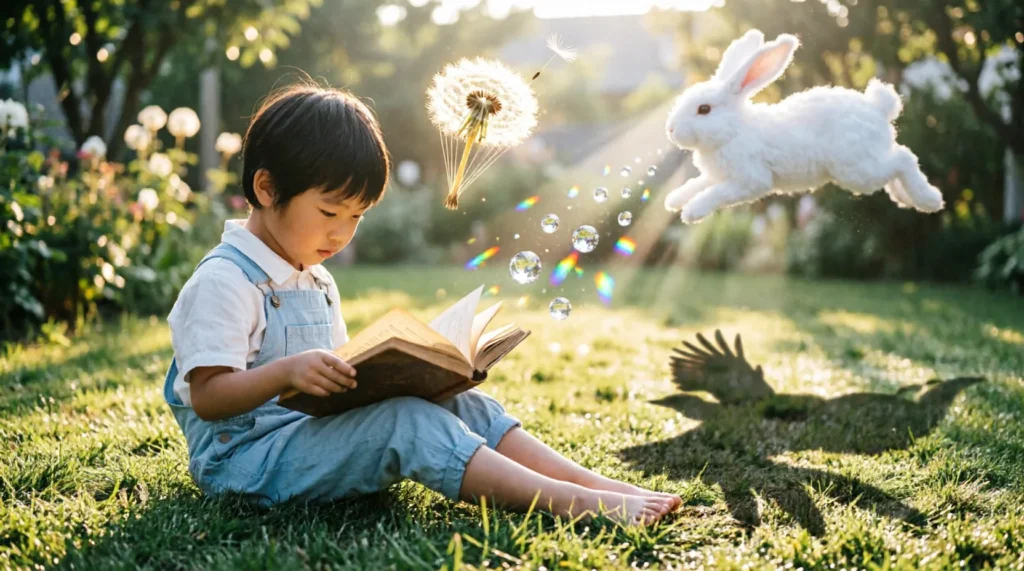
Similes in poetry give young readers a bridge between the familiar and the imaginative, turning abstract feelings into concrete images they can grasp. The poems I’ve gathered here showcase how master poets use “like” and “as” comparisons to make their verses memorable and accessible to children. Use these examples to spark classroom discussions, inspire creative writing exercises, or simply share the joy of well-crafted language with the young readers in your life.
Nature’s Classroom: Similes That Bring the Outdoor World Alive
Children connect instinctively with nature imagery, and these poems use similes to make the natural world feel both wondrous and understandable.
“The fog comes on little cat feet” — “The fog comes on little cat feet, settling silently over the harbor.” (quiet, mysterious) — This is Carl Sandburg’s masterpiece from “Fog,” and it’s the version my students always reach for first when I ask about animal comparisons. The craft here is brilliant: Sandburg doesn’t say the fog is like a cat; he gives it cat feet, making the metaphor so seamless it feels like a simile in spirit. The short, soft consonants mimic the quiet padding of paws.
“My heart is like a singing bird” — “My heart is like a singing bird whose nest is in a watered shoot.” (joyful, exuberant) — From Christina Rossetti’s “A Birthday,” this simile captures that fizzy, overflowing feeling of happiness. I tell my students that Rossetti chose a singing bird specifically—not just any bird—because joy demands expression.
“I wandered lonely as a cloud” — “I wandered lonely as a cloud that floats on high o’er vales and hills.” (contemplative, solitary) — William Wordsworth opens his famous daffodils poem with this comparison, and it’s deceptively simple. The craft note: clouds are both free and isolated, which perfectly sets up the poem’s movement from loneliness to the joy of remembering nature’s beauty.
“The moon was a ghostly galleon tossed upon cloudy seas” — “The moon was a ghostly galleon tossed upon cloudy seas.” (dramatic, adventurous) — Alfred Noyes’s “The Highwayman” uses this extended nautical simile to make the night sky feel dangerous and exciting. My middle schoolers love the swashbuckling energy it brings to a love poem.
“Hope is the thing with feathers” — “Hope is the thing with feathers that perches in the soul.” (delicate, persistent) — Emily Dickinson’s bird simile for hope appears throughout her work, and according to Wikipedia’s entry on famous works, it remains one of the most quoted images in American poetry. The genius is in making something abstract (hope) into something small but sturdy.
“My love is like a red, red rose” — “My love is like a red, red rose that’s newly sprung in June.” (romantic, fresh) — Robert Burns’s classic uses the rose simile, and while some teachers worry it’s too clichéd for kids, I argue that showing students the original source of a cliché helps them understand how overuse drains power from good images.
Emotions Made Visible: Similes for Feelings Kids Recognize
Young writers struggle most with expressing emotions without resorting to “I was sad” or “I was happy.” These poems show how similes make feelings tangible.
“O my Luve is like a red, red rose” — “O my Luve is like a red, red rose that’s newly sprung in June.” (tender, passionate) — Burns returns here because his work demonstrates how a single simile can carry an entire poem’s emotional weight.
“My heart’s a lonely hunter” — “My heart’s a lonely hunter with no game to pursue.” (yearning, melancholic) — While this leans metaphorical, the hunting imagery functions like a simile in how it compares emotional states to physical actions.
“I’m nobody! Who are you? / Are you nobody, too?” — “How dreary to be somebody! How public, like a frog.” (playful, subversive) — Emily Dickinson compares being “somebody” to a croaking frog, and this is the simile I use to teach kids that comparisons can be funny and critical at the same time. The craft: frogs are loud and attention-seeking, which perfectly captures Dickinson’s disdain for fame.
“Life is a broken-winged bird” — “Life is a broken-winged bird that cannot fly.” (tragic, constrained) — Langston Hughes’s “Mother to Son” doesn’t use this exact image, but his work frequently employs bird similes to discuss freedom and limitation. I pair this with discussions about how similes can express hardship without being preachy.
“My sorrow is like a heavy stone” — “My sorrow is like a heavy stone I carry everywhere.” (burdened, weighed down) — This traditional folk poem structure teaches kids that similes can express grief in physical terms they understand.
“Anger is like a storm inside” — “Anger is like a storm inside, with thunder in my chest.” (intense, turbulent) — Modern children’s poets use weather similes because kids experience storms as both fascinating and frightening, making them perfect vehicles for big emotions.
Size and Scale: Similes That Make the Immense Understandable
Children are small people in a big world, so similes that play with size and scale resonate powerfully. These poems help them grasp concepts larger than themselves.
“The sea is a hungry dog” — “The sea is a hungry dog, giant and grey.” (powerful, threatening) — Henry Newlove’s comparison makes the ocean feel alive and dangerous. I use this to teach kids that similes can create mood, not just description.
“The wind is like a whistling top” — “The wind is like a whistling top that spins around the town.” (playful, energetic) — This simile from children’s poetry anthologies works because tops are familiar toys, making the invisible wind suddenly visible and understandable.
“Stars are like diamonds scattered black” — “Stars are like diamonds scattered on black velvet.” (precious, beautiful) — While this borders on cliché now, showing students the original context helps them see why it was once fresh. The craft: diamonds suggest both value and hardness, while velvet suggests softness—the contrast creates tension.
“Time is like a river flowing” — “Time is like a river flowing, never stopping, never slowing.” (inevitable, constant) — This appears in various children’s poems about change, and I use it to discuss how similes can make abstract concepts (time) feel concrete (water).
“The mountain stood like a sleeping giant” — “The mountain stood like a sleeping giant, ancient and still.” (majestic, timeless) — Nature poems for kids frequently use giant similes because children understand both smallness and the idea of something much larger than themselves.
“Her voice was like a silver bell” — “Her voice was like a silver bell, clear and bright.” (pure, musical) — This simile appears in countless children’s poems about singers or speakers, and according to Wikipedia’s discussion of simile, sound-based comparisons are among the oldest figurative language devices because they engage multiple senses.
Everyday Magic: Similes That Transform Ordinary Moments
The best children’s poetry finds wonder in daily life, and these similes show kids how to see the extraordinary in the ordinary.
“The kettle sings like a happy bird” — “The kettle sings like a happy bird when the water starts to boil.” (domestic, cheerful) — I love teaching this one because it transforms a mundane kitchen moment into something musical and alive.
“Rain taps like tiny fingers” — “Rain taps like tiny fingers on the windowpane.” (gentle, persistent) — This simile works because it gives the rain intention and personality without being too anthropomorphic.
“The old house creaked like tired bones” — “The old house creaked like tired bones settling for the night.” (creepy, atmospheric) — Mystery poems for kids use this comparison frequently, and it’s effective because everyone understands the sound of creaking floors and aching joints.
“His laugh bubbled like a spring” — “His laugh bubbled like a spring, clear and unexpected.” (joyful, spontaneous) — This simile captures both the sound and the feeling of genuine laughter.
“The moon hung like a silver coin” — “The moon hung like a silver coin in the dark sky’s pocket.” (precious, distant) — I tell students that adding “in the dark sky’s pocket” extends the simile into a fuller image, showing how one comparison can spark another.
“Sleep came like a warm blanket” — “Sleep came like a warm blanket, wrapping around her tired thoughts.” (comforting, protective) — Bedtime poems for kids rely heavily on comfort similes, and this one works because it engages touch, not just sight.
How to write your own kids’ poem simile
Creating similes for children’s poetry requires balancing freshness with accessibility. Here’s my three-step process that I use in every elementary workshop:
Step 1: Identify the feeling or image you want to convey. Be specific—not just “sad” but “the kind of sad that feels heavy in your chest.”
Step 2: Brainstorm objects, animals, or natural phenomena that share that quality. If you’re writing about loneliness, you might list: empty swing sets, single socks, lighthouses, clouds.
Step 3: Test your comparison by asking: Would a kid my target age understand this? Is it surprising without being confusing?
Worked example: Let’s say you want to describe excitement about Christmas morning.
Feeling: Bouncy, can’t-sit-still, heart-racing excitement. Brainstorm: Popcorn popping, puppies playing, rockets launching, soda fizzing. Test: “My excitement fizzed like soda” works because kids know soda, but “My excitement launched like a rocket” might be stronger because it suggests upward movement and inevitability.
The version I’d choose: “Christmas morning buzzed in my chest like a trapped bumblebee” — it’s specific, sensory, and kids understand both the sound and the frantic energy of a trapped bee.
Frequently Asked Questions
What makes a simile different from a metaphor in children’s poetry?
A simile uses “like” or “as” to make a comparison explicit (“her smile was like sunshine”), while a metaphor states the comparison directly (“her smile was sunshine”). For young readers, similes are often easier to grasp because the comparison word signals that you’re creating an image, not making a literal statement. I introduce similes first in my elementary classes for this reason.
Are famous poems with similes appropriate for all ages?
Not necessarily. Some classic poems contain themes or vocabulary that need scaffolding for younger children. Wordsworth’s “I Wandered Lonely as a Cloud” works beautifully for third grade and up, but Dickinson’s more complex similes might resonate better with middle schoolers who can appreciate her irony. Always read the full poem, not just the simile, to assess age-appropriateness.
How do I help kids avoid clichéd similes like “brave as a lion”?
Show them the original context first—read the poem where that simile appeared and discuss why it was fresh and exciting when first written. Then challenge them to update it: instead of “brave as a lion,” maybe “brave as a kid walking into the principal’s office” or “brave as the first person to try a weird new food.” The goal isn’t to ban traditional similes but to help students understand that originality comes from specificity.
Can similes in poetry be too complex for children?
Yes, if the comparison requires knowledge kids don’t have yet. A simile comparing someone to “a Corinthian column” won’t land with most elementary students. However, don’t underestimate children—they’re often more comfortable with figurative language than adults because they’re still forming their understanding of the world. I’ve seen second graders create stunning similes like “my worry was like a pebble in my shoe” that many adult writers would envy. Trust their intuition while providing guidance on clarity.

William Garcia is a distinguished linguist with over 15 years of experience in the realm of literary arts and education. With a Master’s degree in English Literature from Columbia University, William has dedicated his career to unraveling the beauty of language, particularly focusing on similes and figurative expressions. He discovered his passion for this field during his undergraduate studies when a professor’s insightful analysis of Shakespeare’s use of metaphors sparked his interest. William has since authored numerous articles exploring the depth and impact of figurative language in classic and contemporary texts. At SimileCraft, William combines his academic rigor with a passion for teaching, creating engaging content that helps both new learners and seasoned writers enhance their understanding of metaphorical language. His analytical pieces often delve into the historical progression of similes and their influence on modern literature.